3DAIStudio vs Wan 2.6 AI Video Generator
Side-by-side comparison to help you choose the right product.

3DAIStudio
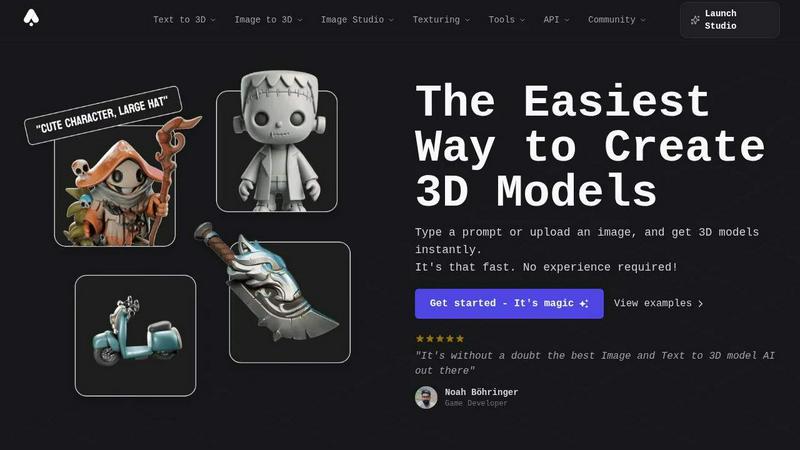
3DAIStudio instantly transforms your text or images into high-quality, production-ready 3D models with AI.
Last updated: April 4, 2026

Wan 2.6 AI Video Generator
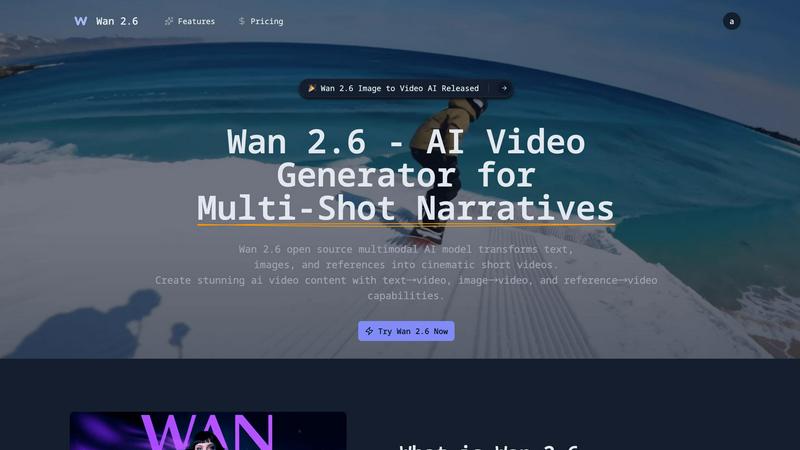
Wan 2.6 transforms your text and images into cinematic videos with advanced AI.
Last updated: March 1, 2026
Visual Comparison
3DAIStudio
Wan 2.6 AI Video Generator
Feature Comparison
3DAIStudio
Text to 3D Generation
This revolutionary feature allows you to materialize imagination into three-dimensional form instantly. Simply type a descriptive prompt—such as "realistic fantasy orc warrior, muscular, wearing rugged armor"—and the AI interprets the text to generate a detailed, textured 3D model. It understands context, style, and physical attributes, providing a powerful tool for rapid prototyping, concept art, and asset creation directly from narrative ideas, all without requiring any prior 3D modeling expertise.
Image to 3D Conversion
Transform any 2D reference—be it a sketch, photograph, or digital illustration—into a fully realized 3D asset. Upload your image, and the AI intelligently extrapolates depth, form, and geometry to construct a three-dimensional model. This is invaluable for turning concept art into usable game assets, creating 3D versions of real-world objects for AR/VR, or giving depth to product designs, significantly accelerating the pipeline from visual reference to functional model.
AI-Powered Texturing & Materials
Go beyond basic geometry with AI that generates physically-based rendering (PBR) textures and materials directly onto your models. You can generate textures from text prompts or paint custom details intuitively. This ensures your assets are not only shaped correctly but also visually rich with realistic surfaces, ready for use in game engines like Unity and Unreal Engine without the need for manual UV unwrapping and texture painting.
Quad-Remesh & Topology Optimization
Produce clean, production-ready geometry with automated retopology tools. The Quad-Remesh feature intelligently optimizes mesh topology, reducing polygon count while preserving form, generating Level of Detail (LOD) models, and ensuring models are animation-friendly and efficient for real-time rendering. This automates a critical and technically demanding step, preparing assets for final export and use in any professional pipeline.
Wan 2.6 AI Video Generator
Multimodal Input Engine
Wan 2.6's sophisticated core accepts and intelligently processes three distinct input modalities: text descriptions, static images, and reference videos. This flexibility allows creators to initiate their vision from any starting point, whether a written script, a key visual, or an existing stylistic reference. The platform seamlessly interprets these inputs to generate coherent video content, adapting its creative process to the user's preferred workflow and providing unparalleled versatility in content ideation and production.
Coherent Multi-Shot Narrative Generation
This advanced feature enables the creation of extended video sequences composed of multiple, logically connected shots. Wan 2.6 excels at maintaining narrative flow and visual continuity across these scenes, allowing for the generation of complex storytelling segments. It intelligently manages transitions, scene composition, and pacing, effectively functioning as an AI-driven director that understands and executes a cohesive visual story from a single, overarching prompt or series of inputs.
Frame-Level Control & Character Consistency
Wan 2.6 provides granular control over the generated output, ensuring meticulous attention to detail at the frame level. Its most notable application is in maintaining perfect character consistency; the AI preserves the identity, appearance, and style of characters across every shot and scene. This eliminates the common AI pitfall of visual drift, guaranteeing that protagonists and elements remain recognizable and true to the creator's original design throughout the entire video narrative.
Professional-Grade Lip-Sync Technology
Incorporating industry-leading audio-visual synchronization, Wan 2.6 features precise lip-sync technology. This ensures that any dialogue or audio elements are perfectly matched with realistic, natural mouth movements of the generated characters. The result is videos that possess a professional, polished quality, significantly enhancing believability and viewer engagement, which is critical for narrative content, advertisements, and character-driven animations.
Use Cases
3DAIStudio
Game Development & Prototyping
Game developers and indie studios can rapidly generate characters, props, weapons, and environmental assets directly from concept art or written descriptions. This dramatically speeds up the pre-production and prototyping phases, allowing for faster iteration on game design and visual style, and enabling smaller teams to produce high-quality 3D content that meets the demands of modern game engines.
Film & Animation Pre-Visualization
Film production and animation studios can use 3DAIStudio to quickly create 3D models for storyboarding, pre-visualization (previs), and animatics. Directors and concept artists can visualize scenes with placeholder assets generated in minutes from script descriptions or mood boards, facilitating creative decision-making and planning before committing to costly, time-intensive final asset production.
Product Design & 3D Printing
Industrial and product designers can upload sketches or photos of a prototype to instantly generate a 3D model for review, presentation, or refinement. The optimized, watertight meshes produced are ideal for preparing files for 3D printing, allowing for rapid iteration on physical product designs and accelerating the journey from initial idea to tangible prototype.
Architectural Visualization & Interior Design
Architects and interior designers can convert 2D floor plans, furniture sketches, or inspiration images into 3D models to populate immersive visualizations and virtual tours. This enables clients to experience a space with realistic furnishings and decor early in the design process, improving communication and streamlining the approval workflow for both residential and commercial projects.
Wan 2.6 AI Video Generator
Cinematic Social Media Content Creation
Content creators and influencers can leverage Wan 2.6 to produce high-quality, narrative-driven short films and promotional clips for platforms like Instagram Reels, TikTok, and YouTube Shorts. The ability to generate cohesive, multi-shot stories from a simple text prompt or image allows for rapid production of visually stunning content that stands out in crowded social feeds, elevating personal and brand storytelling to a cinematic level.
Rapid Advertising & Commercial Prototyping
Marketing teams and advertising agencies can use Wan 2.6 for swift concept visualization and prototype development. The tool enables the fast generation of multiple creative variants for commercial storyboards, allowing for efficient client presentations and creative testing before committing to full-scale production. This accelerates the ideation cycle and reduces costs associated with traditional pre-production filming.
Independent Filmmaking & Animation Pre-Visualization
Independent filmmakers and animators can utilize the platform as a powerful pre-visualization tool. By transforming scripts or concept art into dynamic video sequences, creators can block scenes, experiment with visual styles, and pitch their vision with compelling proof-of-concept footage. The character consistency and multi-shot coherence make it ideal for planning animated shorts or live-action projects with complex visual narratives.
Educational & Explainer Video Production
Educators, trainers, and businesses can create engaging explainer videos and educational content. Starting from a script or a series of key diagrams (images), Wan 2.6 can animate concepts, visualize processes, and bring static information to life. The lip-sync feature is particularly valuable for creating clear, narrated instructional content, making complex topics more accessible and engaging for audiences.
Overview
About 3DAIStudio
3DAIStudio represents a paradigm shift in digital content creation, offering an advanced AI-powered platform that transforms simple text descriptions or two-dimensional images into fully-realized, high-quality 3D models within seconds. It is engineered to democratize 3D asset generation, removing the traditional barriers of technical skill and time-intensive labor. This sophisticated toolkit is designed for a broad spectrum of creative professionals, including game developers, film and VFX artists, product designers, architects, and digital marketers, who require rapid, production-ready assets. The core value proposition lies in its unparalleled speed and accessibility; complex models that once required days of expert modeling and texturing can now be conceptualized, generated, and optimized in minutes. By leveraging cutting-edge artificial intelligence, 3DAIStudio not only accelerates workflows but also unlocks new realms of creative possibility, enabling users to iterate freely and bring their most ambitious visions to life with unprecedented efficiency and fidelity.
About Wan 2.6 AI Video Generator
Wan 2.6 AI Video Generator represents a paradigm shift in digital content creation, offering a sophisticated, open-source multimodal platform engineered for the discerning narrative-driven creator. It transcends conventional video generation by seamlessly synthesizing text prompts, static images, and reference materials into compelling, cinematic short videos. This tool is meticulously designed for professionals who demand both artistic vision and technical precision, including filmmakers, marketing agencies, social media influencers, and animators. Its core value proposition lies in empowering users to craft intricate, multi-shot narratives with an unprecedented level of coherence, visual fidelity, and directorial control. By integrating advanced lip-sync technology and ensuring meticulous character consistency across frames, Wan 2.6 transforms abstract concepts into visually stunning stories. It stands as a versatile cornerstone for enhancing production workflows across advertising campaigns, social media content, and rapid creative prototyping, placing the power of a virtual film studio at your fingertips.
Frequently Asked Questions
3DAIStudio FAQ
What file formats can I export my 3D models in?
3DAIStudio supports exporting models in industry-standard formats compatible with all major 3D software and game engines. This typically includes .GLB (glTF) and .OBJ files, which come with associated texture maps (like albedo, normal, roughness) for PBR workflows. This ensures seamless integration into pipelines using Unity, Unreal Engine, Blender, Maya, and more.
Do I need any prior 3D modeling experience to use 3DAIStudio?
No prior 3D modeling experience is required. The platform is designed to be intuitive and accessible. The core process involves typing a text prompt or uploading an image, with the AI handling the complex tasks of geometry generation, texturing, and topology optimization. It is built for both complete beginners and seasoned professionals looking to enhance their productivity.
How long does it take to generate a 3D model?
Generation is remarkably fast. A textured, initial 3D model can be created from a text prompt or image in a matter of seconds to a few minutes, depending on complexity. This stands in stark contrast to traditional modeling, which can take hours or days. The platform is engineered for speed, enabling rapid iteration and experimentation.
Is the output suitable for commercial use in projects?
Yes, models generated with 3DAIStudio are designed to be production-ready and suitable for commercial use. The tools, like Quad-Remesh and AI texturing, ensure assets have clean topology and professional-grade materials, making them viable for use in commercial games, animations, marketing materials, and product visualizations. Always review the specific license terms for your subscription plan.
Wan 2.6 AI Video Generator FAQ
What types of input does Wan 2.6 accept?
Wan 2.6 is a multimodal AI, meaning it accepts three primary types of input. You can generate videos from a detailed text prompt (Text-to-Video), animate and extend a static image into a dynamic scene (Image-to-Video), or use an existing video as a stylistic and compositional reference to guide the generation of new content (Reference-to-Video). This flexibility supports diverse creative workflows.
How does Wan 2.6 maintain character consistency in multi-shot videos?
The platform employs advanced AI modeling techniques that anchor character identity throughout the generation process. When a character is defined, either through a text description, an uploaded image, or a reference frame, Wan 2.6 encodes this information and ensures it is preserved across all subsequent shots and scenes. This frame-level control prevents visual inconsistencies, making it ideal for creating longer narratives with recurring characters.
Is Wan 2.6 suitable for creating videos with spoken dialogue?
Yes, absolutely. One of Wan 2.6's standout features is its professional-grade lip-sync technology. When provided with an audio track or dialogue, the AI meticulously animates the corresponding character's mouth movements to synchronize perfectly with the spoken words. This results in natural-looking speech that significantly enhances the production quality and realism of narrative videos, explainers, and animated dialogues.
What does it mean that Wan 2.6 is an open-source platform?
Being open-source means the core code and model architecture of Wan 2.6 are publicly accessible. This offers significant advantages for developers and technically advanced users, including the ability to audit the technology, customize the model for specific needs, integrate it into proprietary pipelines, and contribute to its development. It provides transparency and greater creative control compared to closed, proprietary AI systems.
Alternatives
3DAIStudio Alternatives
3DAIStudio represents a significant evolution in the content creation landscape, operating within the burgeoning category of AI-powered 3D asset generation. It empowers users to transmute simple text prompts or static images into detailed, high-quality 3D models with remarkable speed, democratizing a process once reserved for specialists. Users may explore alternatives for a variety of nuanced reasons. These can range from budgetary considerations and specific feature requirements—such as particular export formats or integration capabilities—to the desire for a different user experience or platform compatibility. The quest for a tool that aligns perfectly with one's unique creative workflow and technical ecosystem is a common pursuit. When evaluating other solutions, discerning creators should consider the fidelity and versatility of the generated models, the intuitiveness of the interface, and the overall value proposition. The ideal platform not only accelerates production but also integrates seamlessly into one's existing pipeline, enhancing creativity without imposing technical constraints.
Wan 2.6 AI Video Generator Alternatives
Wan 2.6 AI Video Generator represents a sophisticated tier within the AI video creation landscape, distinguished as an open-source, multimodal platform for crafting narrative-driven cinematic content. It empowers creators to transform text, images, and references into coherent, multi-shot videos with exceptional character consistency and advanced features like lip-sync. Users may explore alternatives for a variety of reasons, including budgetary considerations, the need for a different user experience, or specific platform requirements not fully addressed by a single solution. The search often stems from a desire to find the perfect balance between creative control, output quality, and operational simplicity. When evaluating alternatives, discerning creators should prioritize the core capabilities that align with their vision. Key considerations include the depth of narrative control, the fidelity of character and style consistency across scenes, the quality of motion generation, and the overall coherence of the final video output. The ideal tool should not only generate visuals but also understand and execute a story.