
DeepRails
DeepRails provides hyper-accurate AI guardrails to detect and fix hallucinations before they reach your users.
Visit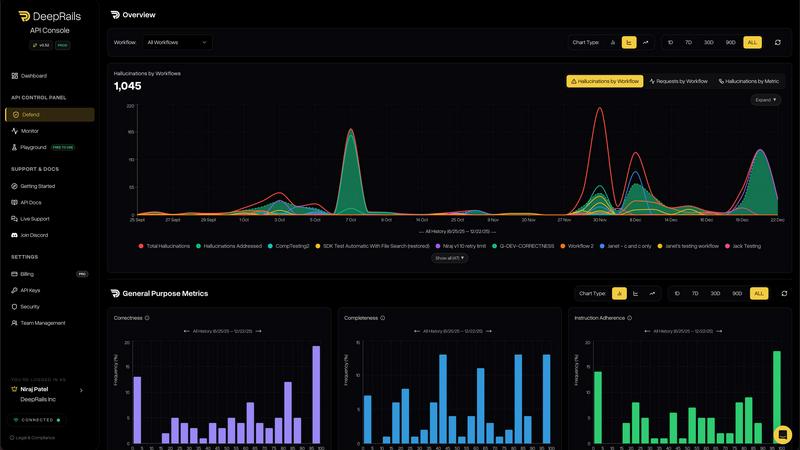
About DeepRails
DeepRails is the essential infrastructure for engineering teams committed to deploying trustworthy, production-grade artificial intelligence. In the critical transition from prototype to product, the pervasive challenge of AI hallucinations and unreliable outputs represents a fundamental barrier to adoption. DeepRails confronts this challenge directly, offering a sophisticated reliability and guardrails platform that moves beyond simple detection to provide substantive correction and control. Designed for the modern AI engineer, it delivers hyper-accurate evaluation of LLM outputs across critical dimensions like factual correctness, contextual grounding, and reasoning consistency, enabling teams to distinguish critical errors from acceptable variance with unparalleled precision. The platform is model-agnostic and production-ready, integrating seamlessly with leading LLM providers and contemporary development pipelines. It empowers organizations to implement automated remediation workflows, define custom evaluation metrics aligned with specific business logic, and establish continuous human-in-the-loop feedback systems that iteratively refine model behavior. For development teams who refuse to compromise on quality, DeepRails is the definitive solution to ship AI you can confidently stand behind.
Features of DeepRails
Defend API: Real-Time Correction Engine
The Defend API acts as a real-time kill-switch for AI hallucinations, positioned between your LLM and your end-user. It automatically scores every model output against configured guardrail metrics, such as factual correctness and instruction adherence. When a potential hallucination or quality breach is detected, the API can trigger automated remediation actions—like invoking a "FixIt" function to correct the text or a "ReGen" command to query a more reliable model—before the flawed output ever reaches your customer. This ensures only vetted, high-quality responses are delivered.
Expansive & Custom Guardrail Metrics
DeepRails provides an extensive library of pre-built, rigorously tested evaluation metrics covering quality, safety, and advanced agentic performance. Teams can choose from metrics like Correctness, Completeness, and Context Adherence, each proven to be significantly more accurate than alternatives like AWS Bedrock. Crucially, the platform also allows for the creation of completely custom metrics tailored to unique domain-specific requirements, enabling granular, business-aligned evaluation of AI behavior.
DeepRails Console for Audit & Analytics
Every interaction processed by the Defend API is logged in real-time to the DeepRails Console. This provides teams with beautiful, actionable dashboards showing key performance indicators like hallucinations caught and fixed, alongside score distributions for all guardrail metrics. Engineers can drill into any individual run to see the full audit trace, including the original output, the evaluation scores with rationales, and the details of any automated improvement chain that was executed.
Seamless Integration & Model Agnosticism
Built by AI engineers for AI engineers, DeepRails is designed for seamless integration into modern development stacks. It offers comprehensive SDKs and a fully-featured API, supporting easy integration with any LLM provider and existing application pipelines. This model-agnostic approach ensures teams can implement robust guardrails and consistent evaluation frameworks across their entire AI ecosystem, regardless of how their underlying models may evolve.
Use Cases of DeepRails
Legal and Compliance Advisory
In legal technology, where citing non-existent case law can have severe consequences, DeepRails is indispensable. It ensures AI-powered legal assistants or research tools provide only factually accurate and contextually grounded information. The platform's Correctness and Context Adherence metrics automatically verify the validity of legal citations and ensure every claim is supported by the provided source documents, preventing costly hallucinations before they reach a lawyer or client.
Financial Services and Customer Support
For banks, fintechs, and insurance companies deploying AI chatbots, accuracy is non-negotiable. DeepRails safeguards these interactions by evaluating the factual correctness of financial advice, policy explanations, or transaction details. It can detect and automatically correct erroneous information regarding interest rates, coverage terms, or regulatory details, ensuring customers receive reliable guidance and maintaining strict compliance standards.
Healthcare Information Systems
In healthcare applications, patient safety depends on flawless information. DeepRails ensures AI systems providing drug interaction details, symptom analysis, or treatment information are rigorously checked for factual accuracy and completeness. The platform's advanced metrics can validate that a response covers all aspects of a complex medical query and that all data is grounded in trusted, provided medical contexts, mitigating the risk of harmful misinformation.
Robust RAG (Retrieval-Augmented Generation) Pipelines
For any team using RAG to ground LLMs in proprietary data, DeepRails is critical for validating system output. Its Context Adherence metric specifically determines whether each factual claim in an AI's answer is directly supported by the retrieved source documents. This prevents the model from "going rogue" and fabricating information, ensuring the RAG system delivers on its promise of accurate, sourced responses from company knowledge bases.
Frequently Asked Questions
How does DeepRails differ from basic LLM output monitoring?
DeepRails moves far beyond passive monitoring. While basic tools might flag potential issues, DeepRails provides hyper-accurate, granular evaluation using proprietary metrics and, most importantly, enables automated real-time correction. It doesn't just tell you something is wrong; it can actively fix hallucinations via its Defend API before they impact users, turning observation into actionable remediation.
Can I create evaluation metrics for my specific business needs?
Absolutely. While DeepRails offers a comprehensive library of best-in-class general-purpose metrics, its platform is built for extensibility. You can define custom guardrail metrics tailored to your unique domain, business rules, and quality thresholds. This allows you to evaluate AI outputs based on your specific definitions of correctness, brand voice, compliance requirements, or any other critical dimension.
Is DeepRails tied to a specific LLM provider?
No, DeepRails is completely model-agnostic. It is designed to integrate seamlessly with any large language model, whether you are using OpenAI, Anthropic, Google Gemini, open-source models, or any other provider. This ensures your guardrails and quality control standards remain consistent even as your underlying AI models and providers evolve.
What is involved in integrating the Defend API?
Integration is straightforward for engineering teams. You simply route your LLM's output through the Defend API endpoint before sending it to your user. The API evaluates the content against your configured guardrails and executes any required improvement actions in milliseconds. DeepRails provides detailed SDKs and documentation to facilitate a quick setup, allowing you to configure workflows, thresholds, and remediation steps in minutes.