Fusedash vs iGPT
Side-by-side comparison to help you choose the right product.

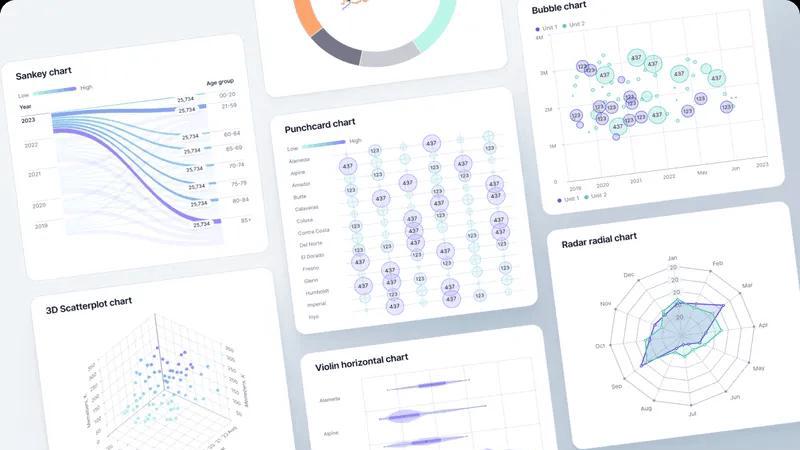
Fusedash transforms raw data into elegant, actionable dashboards and charts for instant team insights.
Last updated: March 4, 2026

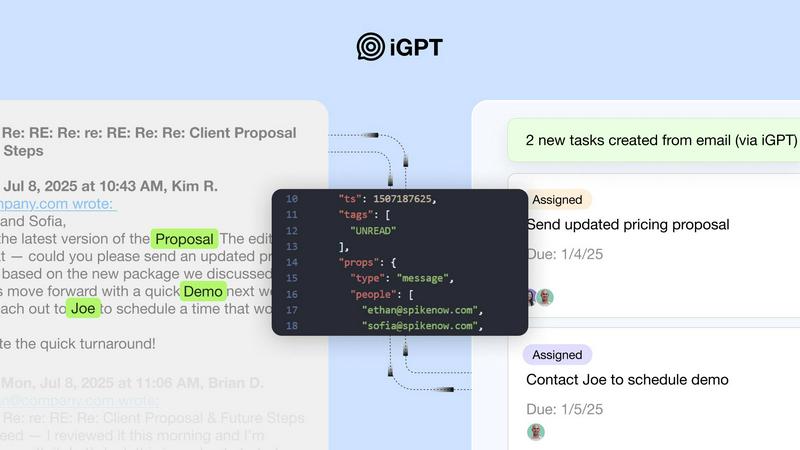
iGPT provides secure, intelligent email context for enterprise AI agents and workflows.
Last updated: February 28, 2026
Visual Comparison
Fusedash
iGPT
Feature Comparison
Fusedash
Unified AI Visualization Workspace
Fusedash consolidates the entire data visualization lifecycle into one elegant environment. Move fluidly between creating interactive dashboards for real-time KPI monitoring, generating standalone AI-powered charts, crafting detailed geographic maps, and authoring contextual narrative reports. This eliminates the need to rebuild logic across disconnected tools, ensuring every visual and insight originates from the same consistent dataset and metric definitions, saving invaluable time and eradicating reporting discrepancies.
AI Chart Generator
Accelerate insight discovery with an intelligent chart generator that transforms your CSVs or API data into clear, compelling visuals in minutes. This feature intelligently suggests optimal chart types, applies meaningful comparisons, and helps refine labels to ensure each visual accurately tells your data's story. Generated charts can serve as powerful standalone assets or be seamlessly integrated into broader dashboards and reports, providing a fast track from raw data to understood insight.
Contextual Storytelling & Reporting
Bridge the gap between data presentation and strategic understanding with integrated storytelling. Fusedash allows you to combine performance dashboards with narrative context, explaining what changed, why it matters, and what the next steps should be. This transforms static reports into dynamic, communicative documents that provide stakeholders with not just the numbers, but the crucial context needed for alignment and confident decision-making.
Smart Data Chat & Exploration
Navigate your data with conversational ease using Fusedash's integrated AI chat. Pose questions in plain language to explore breakdowns, uncover trends, and receive intelligent suggestions for relevant metrics or visualizations. This natural interface democratizes data exploration, allowing users of all technical skill levels to interrogate information and instantly transform their discoveries into shareable, persistent dashboard views.
iGPT
Unified Intelligence Endpoint
iGPT consolidates the entire complexity of context engineering into a single, natural language API call. This unified endpoint seamlessly orchestrates real-time retrieval, sophisticated context shaping, and structured reasoning in one cohesive pipeline. Developers are liberated from the burden of managing multiple disparate services for parsing, vector stores, and prompt chains, enabling them to integrate powerful email intelligence with minimal code and operational overhead.
Autonomous Context Engineering
The platform autonomously handles the intricate tasks required to make email data usable for AI. This includes deep, automatic indexing of messages and attachments, intelligent reconstruction of email threads across time and participants, and optimized context window shaping for large language models. This sophisticated engineering happens behind the scenes, delivering clean, cited, and context-rich answers without any manual prompt tuning or maintenance from the user.
Enterprise-Grade Security Architecture
Security and data sovereignty are foundational to iGPT's design. It operates on a strict zero-data retention policy, processing each inference entirely in memory without storing inputs, prompts, or outputs. Coupled with OAuth-only authentication, rigorous Role-Based Access Control (RBAC), and comprehensive audit trails, it ensures that sensitive communication data never leaves a company's control and is never used to train external models.
Advanced Attachment & Thread Processing
iGPT excels at understanding the full context of communication by deeply processing not just email text, but all embedded attachments—including documents, PDFs, and spreadsheets—extracting their text, data, and structure. Furthermore, it intelligently reconstructs fragmented email threads, piecing together conversations across time and multiple participants to provide a complete and accurate narrative for the AI to reason over.
Use Cases
Fusedash
Executive Leadership & Board Reporting
Provide leadership with a consistent, high-level view of organizational health. Fusedash enables the creation of executive dashboards that aggregate key financial, operational, and customer metrics, complemented by narrative storytelling that highlights achievements, explains variances, and outlines strategic forecasts, ensuring all decision-makers are informed by a single, reliable source of truth.
Marketing Performance & Campaign Analysis
Empower marketing teams to move beyond spreadsheets. Connect advertising platform APIs, CRM data, and web analytics to build dynamic dashboards that track campaign ROI, channel performance, and lead generation in real-time. Use segmentation and drill-downs to understand audience behavior and optimize spend, while sharing clear, visual reports with stakeholders to demonstrate impact.
Operational Monitoring & Geographic Insight
Monitor real-time operational metrics across locations or regions. By integrating map-based visualizations, teams in logistics, retail, or field services can instantly see performance geographically, identify hotspots or underperforming areas, and drill down to understand local drivers. This provides an intuitive, at-a-glance understanding of distributed operations.
Cross-Departmental KPI Alignment
Eliminate departmental silos and conflicting data stories. Fusedash allows organizations to define core company KPIs once and then deploy them across customized dashboards for sales, finance, support, and product teams. This ensures every department is measuring success with the same definitions, fostering alignment and collaborative problem-solving based on unified data.
iGPT
Intelligent Email Assistants & Copilots
Build sophisticated AI agents that can draft, prioritize, summarize, and act on email with full situational awareness. These assistants understand the nuance of long threads, recognize urgency from tone, and can manage inboxes or draft contextually perfect responses by leveraging the entire history of a conversation and its related files.
Automated Workflow & Task Orchestration
Transform unstructured email exchanges into structured, actionable business processes. Automatically extract action items, deadlines, approvals, and decisions from board meetings or project updates, and convert them into tasks in tools like Jira or Asana. Proactively flag stalled conversations or follow-ups that require attention.
Customer Support & Relationship Intelligence
Empower support copilots and CRM agents with the complete customer story. iGPT can instantly rebuild a customer's journey from scattered email chains and attachments, allowing agents to understand past issues, commitments, and sentiment shifts. It can also extract deal momentum, ownership, and key decisions directly from sales threads.
Compliance, Audit, and Insight Generation
Create a verifiable audit trail of feedback, approvals, and operational rationale by tracing every AI-generated insight back to its source emails and attachments. Automatically summarize legal contracts, invoices, or reports within the context of the surrounding email discussion for faster review and insight discovery.
Overview
About Fusedash
Fusedash is the definitive AI-powered data visualization platform engineered for modern teams who demand clarity, consistency, and decisive action from their data. It transcends the limitations of fragmented analytics tools by providing a singular, intelligent workspace where raw data from disparate sources is transformed into a coherent, decision-ready narrative. Designed for organizations weary of manual reporting cycles and conflicting data interpretations, Fusedash establishes a single source of truth. Its core genius lies in operationalizing consistency: key metrics and KPIs are defined once and then seamlessly reused across every dashboard, interactive chart, detailed map, and narrative report. This ensures that leadership, marketing, operations, and beyond are all aligned, viewing and acting upon the same trusted numbers. Beyond mere monitoring, Fusedash empowers deep understanding with intuitive drill-down capabilities and integrated AI features like natural language data chat. It is more than a dashboard tool; it is a comprehensive platform for data storytelling, real-time monitoring, and collaborative insight, turning complex information into a strategic asset that drives organizational alignment and informed action.
About iGPT
iGPT represents the definitive intelligence layer for enterprise communication, engineered to unlock the operational knowledge trapped within email silos. In an age where email remains the central nervous system of business, conventional AI solutions often falter, unable to parse the nuanced, unstructured data of conversations, threads, and attachments. iGPT elegantly solves this by acting as a secure, unified API that transforms complex email data into trusted, context-aware insights ready for autonomous agents and sophisticated AI workflows. Designed for forward-thinking developers and enterprises, its core value proposition is singular: to eliminate the arduous, maintenance-heavy tasks of data parsing, chunking, indexing, and prompt tuning. Instead, it provides a single, intelligent endpoint that handles the entire spectrum of context engineering—from real-time ingestion and hybrid retrieval to intelligent thread reconstruction. This allows organizations to ship reliable, production-ready agents with unparalleled speed, focusing on creating value rather than managing infrastructure. With an unwavering commitment to enterprise-grade security through principles like zero-data retention and strict RBAC, iGPT empowers businesses to automate critical follow-ups, drive agentic workflows, and unlock decision intelligence with absolute confidence and compliance.
Frequently Asked Questions
Fusedash FAQ
What types of data sources can I connect to Fusedash?
Fusedash offers flexible data integration capabilities to suit various workflows. You can start by uploading CSV files directly into the platform for quick analysis. For live, updated data, you can connect to a wide range of sources via API connections. The platform is designed to allow you to combine these datasets into a single, coherent view for comprehensive reporting and analysis.
How does Fusedash ensure data consistency across reports?
Consistency is a foundational principle of Fusedash. The platform allows you to centrally define your key metrics, dimensions, and calculation logic. Once these "single sources of truth" are established, you can reuse them across every dashboard, chart, map, and report you create. This means that whether the CEO or a marketing manager is viewing the data, they are guaranteed to be looking at numbers calculated the same way, eliminating conflicts and building trust.
Can I use Fusedash for real-time data monitoring?
Absolutely. Fusedash is built for both reflective analysis and proactive monitoring. By connecting to live data sources via APIs, you can create real-time interfaces and dashboards that update automatically. This allows teams to monitor critical KPIs, track live campaign performance, or oversee operational metrics as they happen, enabling swift identification and response to trends or issues.
Is technical expertise required to use the AI Chat and Chart Generator?
Not at all. A core design goal of Fusedash is to make advanced data exploration accessible. The AI Chart Generator guides you through visualization choices based on your data. The Smart Data Chat feature is designed for natural language interaction—you can ask questions like "What were sales by region last quarter?" or "Show me a trend of website traffic," and the AI will help find the answers and suggest appropriate visuals, requiring no code or complex query writing.
iGPT FAQ
How does iGPT handle data privacy and security?
iGPT is built with enterprise-grade security as a core principle. It employs a zero-data retention model, meaning your data is processed in memory for the duration of an API call and is never written to disk or stored. Data is never used to train models. Access is strictly controlled via OAuth and RBAC, and every action is logged to a full audit trail, ensuring complete data sovereignty and compliance.
What is the "unified endpoint" and how does it simplify development?
The unified endpoint is a single API call (like /v1/recall/ask/) that replaces the need for a complex, multi-step retrieval-augmented generation (RAG) pipeline. Instead of developers managing separate services for ingestion, chunking, embedding, vector search, and prompt engineering, they simply send a natural language query. iGPT internally handles all those steps—retrieval, context shaping, and reasoning—returning a structured, cited answer.
Can iGPT process attachments within emails?
Yes, advanced attachment processing is a key capability. iGPT automatically extracts and indexes text, data, and structural information from a wide variety of file attachments, including PDFs, Word documents, spreadsheets, and presentations. This content is then made available for retrieval and reasoning in the context of the email thread, allowing questions about data within a report or terms in a contract to be answered accurately.
How quickly can I integrate and start using iGPT?
Integration is designed for immediacy. iGPT provides a live playground to test API requests with your own data, comprehensive SDKs, and detailed documentation. You can connect email sources, and the platform begins deep indexing automatically. This allows developers to go from sign-up to receiving contextual answers from their email data in a very short timeframe, accelerating prototyping and production deployment.
Alternatives
Fusedash Alternatives
Fusedash is an AI-powered data visualization and business intelligence platform designed to transform raw data into a unified source of truth. It enables teams to create consistent, decision-ready dashboards and reports, ensuring organizational alignment and action from a single workspace. Users may explore alternatives for various reasons, including specific budgetary constraints, the need for specialized features beyond core visualization, or integration requirements with a particular technical stack. The search often stems from a desire to find a solution that aligns perfectly with a team's unique scale, workflow, and data maturity. When evaluating options, it is essential to consider not only the breadth of visualizations but also the underlying architecture for data consistency. Key differentiators often lie in the efficiency of maintaining metric definitions, the depth of real-time analysis, and the sophistication of tools that democratize data access across all team members, from analysts to executives.
iGPT Alternatives
iGPT represents the pinnacle of enterprise-grade intelligence for communication data, a sophisticated layer engineered to transform unstructured email and messaging content into secure, actionable context for AI agents and workflows. As a definitive solution in business intelligence, it addresses the critical challenge of unlocking operational knowledge trapped within communication silos with unparalleled security and speed. Organizations may explore alternatives for various strategic reasons, including specific budget constraints, the need for different integration capabilities, or a preference for building bespoke internal systems. The landscape offers a spectrum of approaches, from foundational API toolkits to more specialized data processing platforms. When evaluating options, discerning enterprises should prioritize solutions that offer robust, auditable security protocols, genuine proficiency in handling the nuanced complexity of communication threads, and a clear path to reliable production deployment. The true measure lies in a platform's ability to deliver trusted, context-aware intelligence without imposing unsustainable maintenance burdens or compromising on data sovereignty.