Karolium vs Miget
Side-by-side comparison to help you choose the right product.

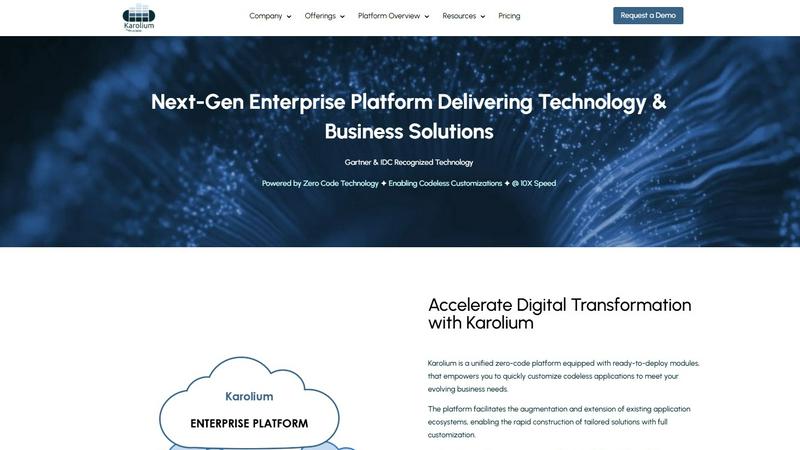
Karolium is a zero-code platform enabling enterprises to effortlessly create and customize intelligent applications for.
Last updated: February 28, 2026

Miget
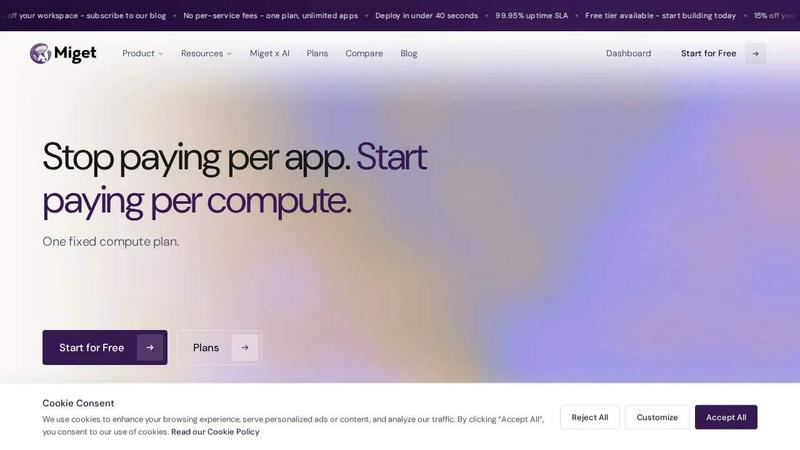
Miget offers a single flat-rate plan for unlimited app deployments, eliminating per-service fees and unpredictable costs.
Last updated: April 13, 2026
Visual Comparison
Karolium
Miget
Feature Comparison
Karolium
Unified Zero-Code Platform
Karolium's foundation lies in its zero-code capability, enabling users to create and customize applications without the need for traditional programming. This empowers non-technical users to engage directly in the development process, enhancing productivity and accelerating time-to-market for new solutions.
Pre-Composed Modules
The platform offers a suite of ready-to-use, pre-composed modules that organizations can leverage to augment existing application ecosystems effortlessly. This composability allows for tailored workflows that align precisely with business needs, eliminating the need for extensive redevelopment.
AI-Driven Business Intelligence
Karolium provides built-in predictive and prescriptive analytics, enabling enterprises to make informed decisions backed by data. This feature allows organizations to foresee trends, optimize operations, and implement strategies that align with future market demands.
Continuous Access and Enhancements
Delivered as a managed PaaS-driven SaaS platform, Karolium ensures users have continuous access to the latest capabilities and regular updates. This commitment to evolution allows organizations to stay ahead of technological advancements and market shifts without incurring additional costs.
Miget
Predictable Compute-Based Pricing
Miget eliminates the surprise of per-service billing by adopting a transparent compute-centric model. You select a plan based on your required CPU and memory resources, and that single, fixed cost covers every application, PostgreSQL database, Redis instance, and background worker you deploy within it. This financial clarity empowers teams to experiment liberally, clone environments for testing, and architect microservices without the constant overhead of cost calculation, turning infrastructure back into a creative tool rather than a budgetary constraint.
Unlimited Services per Plan
Within the confines of your chosen compute plan, Miget imposes no arbitrary limits on the number of services you can operate. Deploy dozens of applications, spin up multiple dedicated databases for different workloads, and run numerous background workers—all for the same predictable monthly fee. This feature is the practical execution of the "pay for capacity, not components" philosophy, ensuring you fully utilize your reserved resources and scale your software architecture organically.
Full-Stack Preview Environments
Every pull request automatically generates a complete, isolated preview environment that mirrors your production stack, including its own application instance, database, and data. This provides a robust staging area for testing and collaboration, accessible via a unique URL. It allows stakeholders to review features in a real-world context without affecting live data, significantly improving development workflow and quality assurance.
GitHub-Native Zero-Config Deploys
Miget integrates seamlessly with your GitHub workflow to provide a frictionless deployment pipeline. Simply connect your repository, and Miget handles the rest: automatic builds on push, intelligent caching for speed, and deployment to production or preview environments. This eliminates complex CI/CD configuration, enabling deployments in under 40 seconds and allowing developers to focus solely on writing code.
Use Cases
Karolium
Accelerating Digital Transformation
Organizations looking to rapidly build and deploy new applications can utilize Karolium to streamline their digital transformation efforts. By eliminating the complexities of traditional coding, businesses can focus on innovation and adaptability.
Enhancing Operational Agility
Karolium empowers enterprises to adapt swiftly to changing market conditions by providing a flexible platform that supports real-time collaboration and decision-making. This agility is crucial for maintaining competitiveness in today’s fast-paced business landscape.
Optimizing Supply Chain Management
With features designed for modern supply chain demands, Karolium enables businesses to improve supplier collaboration and centralize procurement processes. This results in enhanced efficiency, reduced costs, and improved supplier relationships across the board.
AI Integration for Intelligent Applications
Organizations eager to leverage AI across their operations can deploy Karolium to seamlessly integrate AI-driven solutions. From demand forecasting to asset monitoring, the platform facilitates the creation of intelligent applications that drive measurable business outcomes.
Miget
Rapid Prototyping and AI-Powered Development
For developers and "vibe coders" experimenting with AI-generated code, Miget offers an instant deployment pathway. By using tools like skills.md for one-click infrastructure setup and deploying directly from prompts, users can bypass traditional Git and terminal workflows. Instant preview URLs allow for immediate sharing and iteration, making it ideal for validating concepts and building MVPs at unprecedented speed.
Indie Hacker and Startup Launchpad
Solo founders and small teams can launch full-stack applications with a predictable, low-cost infrastructure. Miget provides a complete PaaS—encompassing application hosting, managed databases, and caching—under one simple, fixed monthly bill. This predictability is crucial for bootstrapped projects, allowing founders to manage cash flow effectively while benefiting from push-to-deploy automation and per-PR previews.
Scaling Microservices for Growing Teams
As applications evolve into complex microservices architectures, traditional PaaS costs can spiral. Miget allows engineering teams to scale their service count horizontally within their existing compute allocation, keeping costs fixed. Features like team roles, audit logs, custom domains with automatic TLS, and multi-region support provide the governance and reliability needed for serious production workloads without re-platforming.
Enterprise-Grade Custom Deployments
For organizations with specific compliance, security, or infrastructure requirements, Miget offers the flexibility to bring your own cloud or bare metal. It supports industry-standard tooling like Helm charts and Terraform for custom orchestration, coupled with dedicated support, stringent SLAs, and compliance tooling. This enables enterprises to adopt Miget's elegant developer experience while maintaining full control over their underlying infrastructure.
Overview
About Karolium
Karolium represents a groundbreaking advancement in enterprise technology, functioning as a unified zero-code platform that empowers organizations to break free from the limitations of traditional software solutions. Designed for enterprises aiming to accelerate their digital transformation journey, Karolium enhances operational agility and enables businesses to leverage artificial intelligence without the complexities typically associated with custom coding. This sophisticated platform is tailored for organizations that seek to extract greater value from their existing application ecosystems, allowing for the rapid construction of bespoke solutions and seamless integration of predictive intelligence into core operations. By offering ready-to-deploy modules and a codeless customization environment, Karolium facilitates the swift development and enhancement of business applications, thus bridging the gap between legacy systems and modern microservices-ready applications. It is this holistic, intelligent platform that fosters seamless collaboration, proactive market navigation, and the strategic evolution of the enterprise as a whole.
About Miget
Miget represents a paradigm shift in cloud platform engineering, moving beyond the antiquated pay-per-component model to a truly developer-centric approach. It is a modern Platform-as-a-Service (PaaS) built for engineers who value simplicity, predictability, and unfettered creativity. At its core, Miget operates on a revolutionary principle: you purchase a fixed allocation of compute resources, and within that secure, isolated environment, you can deploy an unlimited number of applications, managed databases, background workers, and preview environments. This model dismantles the financial friction of traditional PaaS, where every new microservice, database instance, or testing environment inflates the monthly invoice. Miget is engineered for everyone from solo indie hackers and AI tinkerers to growing startups and enterprise teams, offering a production-ready foundation with a 99.95% uptime SLA, GitHub-native deployments, and full-stack previews. It delivers the raw power and cost predictability of a VPS with the effortless developer experience of Heroku, enabling you to scale your ideas, not your infrastructure budget.
Frequently Asked Questions
Karolium FAQ
What types of businesses can benefit from Karolium?
Karolium is designed for enterprises across various sectors seeking to enhance their operational efficiency, accelerate digital transformation, and leverage AI without the need for extensive coding knowledge.
How does Karolium integrate with existing systems?
Karolium provides seamless integration capabilities that allow organizations to connect with both legacy systems and modern microservices applications, ensuring a smooth transition and enhanced functionality.
Is there support available for users of Karolium?
Yes, Karolium offers comprehensive support resources, including documentation, training materials, and customer service to assist users in maximizing the platform's capabilities.
How frequently are new features and modules released?
Karolium follows a quarterly release schedule, providing users with new modules and enhancements regularly. This ensures that businesses can continuously access the latest features and improvements without additional costs.
Miget FAQ
How does the pricing work compared to traditional PaaS?
Unlike traditional platforms that charge separately for each app dyno, worker, database, and add-on, Miget uses a compute-based model. You choose a plan with a specific amount of CPU and memory (e.g., 1GB RAM, 1 vCPU) for a fixed monthly price. Within that resource allocation, you can run an unlimited number of any service—web apps, databases, workers—with no additional per-service fees. Your bill is predictable and only scales if you choose to upgrade your compute plan.
What is included in the free tier?
Miget offers a free tier designed to let you start building and testing immediately. It includes a modest allocation of compute resources, allowing you to deploy applications and services at no cost. This is perfect for hobby projects, initial experimentation, and learning the platform. Specific resource limits are detailed on the Miget website, and you can upgrade to a paid plan at any time for more capacity and production features.
How are preview environments created and managed?
Preview environments are created automatically for every pull request in a connected GitHub repository. Miget clones your application code, its associated databases, and data to spin up a fully isolated, functional copy of your stack. Each preview is given a unique, shareable URL and is automatically cleaned up when the pull request is merged or closed. This happens within your existing compute plan, so there are no extra charges for creating these environments.
What kind of support and reliability does Miget guarantee?
Miget is built for production workloads and offers a 99.95% uptime Service Level Agreement (SLA) on its platform. Support is available 24/7 to assist with any issues. The platform is built on Kubernetes with full isolation between tenants, ensuring security and stability. For enterprise customers, dedicated support options and enhanced SLAs are available to meet stringent operational requirements.
Alternatives
Karolium Alternatives
Karolium is an advanced zero-code platform designed to empower enterprises in crafting and customizing intelligent applications that drive digital transformation. As a unified solution, it enables organizations to overcome the constraints of traditional software development, facilitating rapid deployment and integration of tailored applications. Businesses often seek alternatives to Karolium for various reasons, including pricing considerations, specific feature sets, or unique platform requirements that may not align perfectly with their operational needs. When exploring alternatives, it is crucial to evaluate factors such as ease of use, scalability, integration capabilities, and the breadth of pre-composed modules offered. Additionally, potential users should consider the level of support and documentation available, ensuring that the chosen platform not only meets their current demands but also adapts to future challenges in a dynamic business environment.
Miget Alternatives
Miget is a modern platform-as-a-service solution that reimagines cloud deployment economics. It belongs to the category of low-code and no-code platforms, simplifying infrastructure management so developers can focus on building applications rather than configuring servers. Its core proposition is a flat-rate compute plan that allows for unlimited services, a significant departure from traditional per-resource billing. Users often explore alternatives for various reasons. Some may require specific, niche features not yet offered, while others might be constrained by budgetary considerations or have unique compliance and platform integration needs that necessitate a different architectural approach. The search for the right tool is a natural part of building a resilient and cost-effective technology stack. When evaluating other platforms, key considerations should align with your core requirements. Assess the pricing model's predictability, the ease of deployment and developer experience, the robustness of managed data services, and the overall security and isolation guarantees. The ideal platform should not only fit your current project scale but also gracefully accommodate future growth without punitive cost structures.