Agenta vs HookMesh
Side-by-side comparison to help you choose the right product.

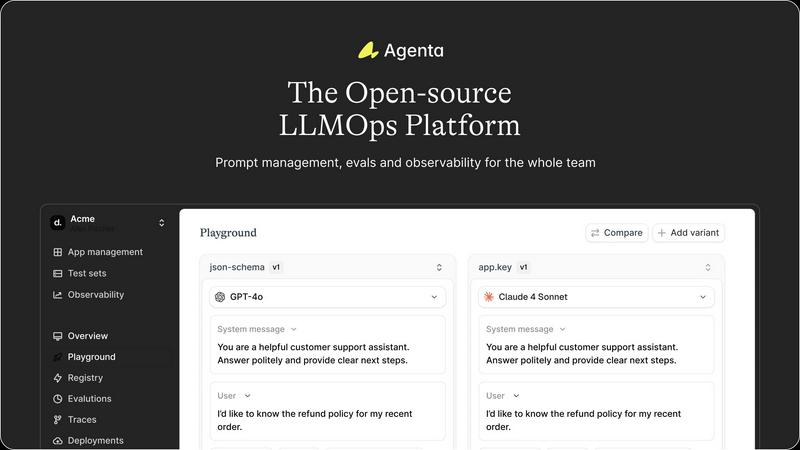
Agenta is an open-source LLMOps platform that unifies teams to build reliable AI applications with streamlined.
Last updated: March 1, 2026

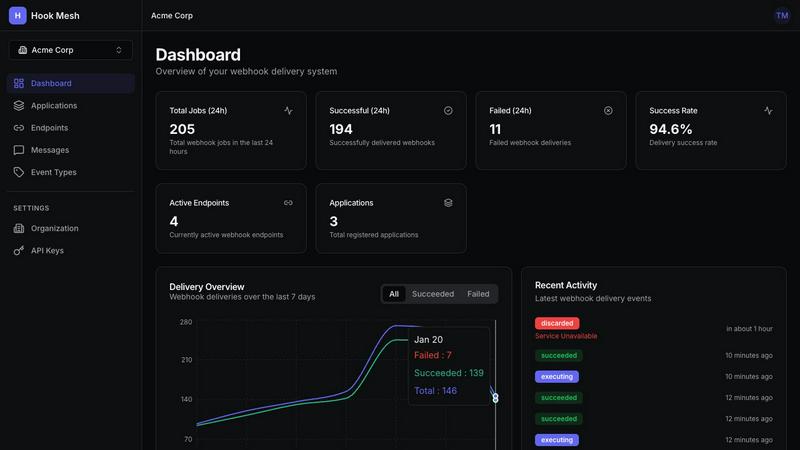
Elevate your SaaS with HookMesh, ensuring seamless webhook delivery, automatic retries, and a user-friendly customer.
Last updated: February 26, 2026
Visual Comparison
Agenta
HookMesh
Feature Comparison
Agenta
Centralized Management
Agenta consolidates all elements of LLM development, including prompts, evaluations, and traces, into one cohesive platform. This centralization eliminates the chaos of disparate tools and provides a streamlined approach to managing the entire LLM lifecycle.
Unified Playground
With Agenta's unified playground, teams can compare different prompts and models side-by-side, allowing for comprehensive analysis and informed decision-making. This feature supports quick iterations and fosters an environment of continuous improvement.
Automated Evaluation
Agenta facilitates a systematic process for running experiments and tracking results through automated evaluations. By integrating various evaluators—including LLM-as-a-judge and custom code evaluators—teams can validate changes with confidence and precision.
Observability and Debugging
With robust observability features, Agenta enables teams to trace every request and identify exact failure points within their AI systems. This functionality enhances debugging capabilities, allowing teams to annotate traces collaboratively and turn any trace into a test with a single click.
HookMesh
Reliable Delivery
HookMesh ensures that webhooks are never lost, providing automatic retries that intelligently handle failures. With exponential backoff and jitter, the platform attempts delivery for up to 48 hours, safeguarding against transient issues.
Circuit Breaker
This feature automatically disables failing endpoints, preventing them from clogging the delivery queue. Once the endpoint recovers, it is seamlessly re-enabled, ensuring that only functional endpoints are operational.
Customer Portal
Empowering users with a self-service portal, HookMesh offers an embeddable UI for endpoint management. Customers can easily view delivery logs, manage their endpoints, and replay failed webhooks with just one click.
Developer Experience
Designed with developers in mind, HookMesh provides a comprehensive REST API and SDKs for JavaScript, Python, and Go. This enables rapid integration, allowing teams to send webhook events quickly and efficiently while focusing on their primary product objectives.
Use Cases
Agenta
Collaborative Prompt Development
Agenta is ideal for teams seeking to enhance their collaborative efforts in prompt development. By providing a shared platform, teams can experiment, compare, and version prompts collectively, thereby improving the overall quality of their LLM applications.
Systematic Evaluation Processes
Organizations can leverage Agenta to implement systematic evaluation processes for their AI models. By tracking results and validating every change, teams can ensure that their models are continuously improving and meeting performance benchmarks.
Debugging and Trace Management
When issues arise, Agenta provides the tools necessary for effective debugging. Teams can trace requests, identify failure points, and gather user feedback, thus enabling a rapid response to problems and fostering a culture of continuous improvement.
Integration with Existing Workflows
Agenta seamlessly integrates with existing tools and frameworks, such as LangChain and OpenAI, making it an invaluable asset for organizations looking to enhance their LLMOps capabilities without disrupting their current workflows.
HookMesh
E-Commerce Transactions
In e-commerce platforms, timely delivery of order notifications is critical. HookMesh ensures that webhook events, such as order confirmations and shipping updates, are reliably transmitted, enhancing customer satisfaction and operational efficiency.
Payment Processing
For payment gateways, HookMesh facilitates the secure and consistent delivery of transaction notifications. Its robust infrastructure prevents loss of critical payment events, ensuring that merchants receive timely updates on payment statuses.
SaaS Integrations
HookMesh is ideal for SaaS products that require seamless integration with third-party services. By managing webhook delivery, it allows businesses to maintain smooth operations without excessive manual intervention or technical overhead.
Event-Driven Architectures
In event-driven systems, HookMesh efficiently handles the complexities of event propagation. Its automatic retries and visibility features ensure that events are delivered reliably, allowing applications to respond promptly to changes and user actions.
Overview
About Agenta
Agenta is the definitive open-source LLMOps platform meticulously crafted for sophisticated AI teams intent on developing and deploying reliable, production-grade LLM applications. In an era where the complexities of large language model (LLM) development often lead to chaos—characterized by scattered prompts, siloed teams, and unvalidated deployments—Agenta emerges as a beacon of order and efficiency. This platform not only centralizes the entire LLM development lifecycle but also fosters collaboration among developers, product managers, and domain experts. With Agenta, organizations can transform their fragmented workflows into structured, evidence-driven processes. By providing a single source of truth, it enables teams to experiment with prompts and models, conduct systematic evaluations, and debug issues with unparalleled precision. Agenta empowers organizations to replace guesswork with governance, ensuring the delivery of innovative and reliable AI products that meet market demands while upholding the highest quality standards.
About HookMesh
HookMesh is a pioneering platform crafted to revolutionize webhook delivery for modern Software as a Service (SaaS) products. It adeptly navigates the intricacies associated with in-house webhook management, including the challenges of retry logic, circuit breakers, and debugging delivery complications. By leveraging HookMesh, organizations can shift their focus back to their core offerings without the burden of webhook management complexities. This sophisticated solution boasts a robust infrastructure that guarantees reliable webhook delivery, equipped with features such as automatic retries, exponential backoff, and idempotency keys. Tailored for developers and product teams, HookMesh not only enhances user experience but also ensures that webhook events are delivered consistently and reliably. With an intuitive self-service portal, users can manage endpoints effortlessly, gain visibility into delivery status, and replay failed webhooks with a simple click, making HookMesh the quintessential choice for organizations seeking tranquility in their webhook strategy.
Frequently Asked Questions
Agenta FAQ
What types of teams can benefit from Agenta?
Agenta is designed for a diverse range of teams, including developers, product managers, data scientists, and domain experts. Its collaborative features unify these roles, enhancing communication and workflow efficiency.
How does Agenta enhance collaboration among team members?
Agenta provides a centralized platform where team members can share prompts, conduct evaluations, and debug issues together. This collaborative environment fosters transparency and encourages collective problem-solving.
Is Agenta suitable for both small and large organizations?
Absolutely. Agenta's scalable architecture makes it suitable for organizations of all sizes, from startups to large enterprises, enabling them to adopt best practices in LLMOps regardless of their scale.
Can I integrate Agenta with my existing LLM frameworks?
Yes, Agenta is designed to integrate seamlessly with various LLM frameworks and tools, allowing teams to build upon their existing infrastructure without facing vendor lock-in or unnecessary complications.
HookMesh FAQ
What are webhooks and why are they important?
Webhooks are automated messages sent from apps when something happens. They allow for real-time communication between services, enabling efficient data transfer and notifications that enhance user experiences.
How does HookMesh handle webhook delivery failures?
HookMesh employs automatic retries with exponential backoff and jitter to manage delivery failures. If an endpoint fails, it is auto-disabled, and once it recovers, it is re-enabled, ensuring reliable event delivery.
Can customers manage their own endpoints?
Yes, HookMesh provides a self-service portal that allows customers to manage their endpoints, view delivery logs, and replay failed webhooks, giving them full control and transparency.
Is there a free tier available for HookMesh?
Absolutely, HookMesh offers a free tier that includes 5,000 webhooks per month with no credit card required, allowing businesses to explore its features without any financial commitment.
Alternatives
Agenta Alternatives
Agenta is an open-source LLMOps platform that caters to sophisticated AI teams focused on developing reliable, production-grade LLM applications. As the definitive solution for managing the complexities inherent in modern LLM development, it offers a structured environment for collaboration among developers, product managers, and domain experts. Users often seek alternatives to Agenta due to various factors such as pricing constraints, feature sets that may not align with specific project needs, or the desire for integration with existing platforms. When considering alternatives, it is essential to evaluate the capabilities of a platform in terms of its support for collaborative experimentation, automated evaluation processes, and overall usability. Additionally, users should assess how well an alternative can centralize the LLM development lifecycle, ensuring a seamless transition from development to deployment while maintaining the integrity and reliability of AI applications.
HookMesh Alternatives
HookMesh is a sophisticated platform designed to enhance webhook delivery for SaaS applications, streamlining the complexities associated with managing webhooks in-house. It provides reliable delivery mechanisms, automatic retries, and a self-service portal that empowers users to engage with their webhook events seamlessly. As the demands of businesses evolve, users often seek alternatives to HookMesh for various reasons, including pricing considerations, specific feature requirements, or compatibility with diverse platform needs. When exploring alternatives, it is crucial to assess the reliability of delivery mechanisms, the user experience provided by the customer portal, and the overall flexibility of the solution. Users should prioritize platforms that offer robust support for managing webhook events while ensuring transparency and control. Evaluating these aspects will enable businesses to find a solution that aligns with their unique requirements and enhances their webhook strategy.