
HiAPI
HiAPI provides a single, unified API for leading AI image, video, and text generation models with persistent storage.
Visit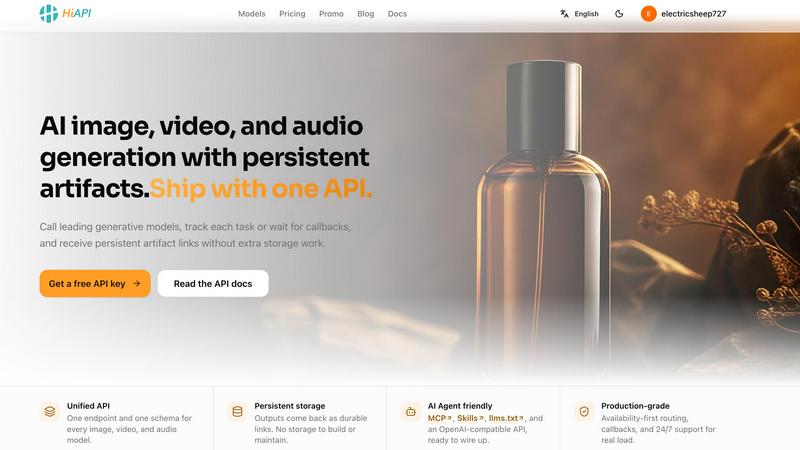
About HiAPI
HiAPI is a developer-first AI API platform that redefines how teams integrate generative artificial intelligence into their applications. It provides a unified gateway for accessing leading models across image, video, text, and audio generation through a single, elegant interface. Instead of managing multiple API keys, disparate billing systems, and incompatible request formats, developers work with one endpoint, one schema, and one consistent workflow. The platform supports OpenAI-compatible requests, making migration seamless for teams already familiar with that ecosystem. Beyond mere model access, HiAPI introduces persistent artifact storage, meaning every generation output returns as a durable link that requires no additional infrastructure to manage. This eliminates the burden of building and maintaining separate storage systems for AI-generated content. The platform is architected with a task-based lifecycle, where each generation request becomes a trackable job with status updates, optional callbacks, and idempotency guarantees. HiAPI is designed for production-grade workloads, featuring availability-first routing, 24/7 support, and transparent pay-as-you-go pricing. It serves a broad audience, from solo developers prototyping creative tools to enterprise teams deploying AI agents at scale. With support for models like Seedream 5.0 Pro, GPT Image 2, FLUX 1.1 Pro, Seedance 2.0, and MiniMax Music 2.6, HiAPI positions itself as the central nervous system for any application requiring generative AI capabilities.
Features of HiAPI
Unified API Architecture
HiAPI collapses the complexity of multiple AI providers into a single, coherent interface. Every model, whether for image generation, video synthesis, or audio creation, is accessible through the same endpoint and request schema. Developers pass a model name, provide input parameters, and optionally configure routing, storage, and callbacks. This uniformity eliminates the need to learn different APIs for each provider, drastically reducing integration time and maintenance overhead. The platform validates parameters per request, ensuring that only compatible inputs reach each model.
Persistent Artifact Storage
Every output generated through HiAPI comes back as a durable, persistent link that remains accessible without additional storage infrastructure. When the storage parameter is set to persistent, the platform automatically retains the generated artifact at a low cost. This feature eliminates the need for developers to build, secure, and maintain their own storage solutions for AI-generated content. Artifacts are instantly available for retrieval, sharing, or further processing, making HiAPI particularly valuable for applications that require reliable access to generated media over time.
AI Agent Readiness
HiAPI is purpose-built for the age of autonomous agents. It supports Model Context Protocol (MCP), reusable Skills, and llms.txt integration, allowing both human developers and AI agents to discover, call, and compose the platform effortlessly. Agents can paste a single prompt from the llms.txt file to understand the entire API surface, then choose between Skills, Remote MCP, or direct API calls as their integration path. This makes HiAPI compatible with popular agent frameworks like Claude, Cursor, and Codex out of the box.
Production-Grade Task Management
The platform implements a sophisticated task lifecycle that ensures reliability at scale. Each generation request returns a task ID immediately, and retries with the same idempotency key do not create duplicate tasks. Developers can poll for status updates or set up callbacks to receive notifications upon completion. Availability-first routing directs requests to the most reliable endpoints, while 24/7 support ensures that production workloads receive timely assistance. This architecture is designed to handle real-world load without compromising on consistency or performance.
Use Cases of HiAPI
Creative Application Development
Developers building creative tools such as image editors, video generators, or music production software can leverage HiAPI to integrate multiple AI models through a single API. Instead of negotiating separate contracts and integrations with each model provider, teams can focus on their application logic while HiAPI handles the complexity of model routing, billing, and storage. The persistent artifact feature ensures that generated content remains accessible for editing, sharing, or versioning without additional engineering effort.
AI Agent Workflow Automation
Autonomous agents and AI assistants can use HiAPI as their generative engine for producing images, videos, and audio on demand. An agent tasked with creating marketing materials can call HiAPI to generate product images, compose background music, and produce promotional videos using different models, all through the same task-based workflow. The MCP and Skills integration allows agents to discover and invoke these capabilities autonomously, enabling sophisticated multi-step creative workflows without human intervention.
Enterprise Content Production
Marketing teams and content studios can integrate HiAPI into their production pipelines to generate visual and audio assets at scale. With transparent pricing and predictable costs, enterprises can estimate expenses before committing to large campaigns. The unified billing system consolidates charges from multiple model providers into a single invoice, simplifying financial operations. Callback functionality enables automated post-processing workflows, such as resizing generated images or adding watermarks, triggered upon task completion.
Prototyping and Rapid Experimentation
Solo developers and small teams exploring generative AI can use HiAPI to quickly prototype ideas without upfront infrastructure investment. The free credits upon signup allow experimentation with multiple models, while the pay-as-you-go pricing ensures that costs scale only with actual usage. Developers can test different models for the same task, compare outputs, and select the best performer before committing to a specific provider. The OpenAI-compatible request format further reduces the learning curve for teams already familiar with that ecosystem.
Frequently Asked Questions
How does the unified API work across different model types?
HiAPI abstracts all model interactions behind a single endpoint: POST /v1/tasks. Each request includes a model parameter that specifies the exact model and capability, such as gpt-image-2/text-to-image or seedream-5.0-pro/text-to-image. The input parameter contains model-specific settings, which are validated per request to ensure compatibility. This design allows developers to switch between image, video, and audio models by simply changing the model name and input parameters, without altering the fundamental request structure.
What is persistent artifact storage and how does it work?
Persistent artifact storage is a feature that automatically retains generated outputs as durable, accessible links. When you set the storage parameter to persistent in your API request, HiAPI stores the resulting image, video, or audio file on its infrastructure. The response includes a URL that remains valid for long-term access. This eliminates the need for developers to implement their own file storage, handle file uploads to cloud services, or manage content delivery networks for AI-generated media.
How does HiAPI support AI agents and autonomous workflows?
HiAPI provides three distinct integration paths for AI agents. First, the Model Context Protocol (MCP) exposes the platform as a set of tools that agents can discover and invoke. Second, Skills are reusable, pre-written instructions that guide agents through common workflows. Third, the llms.txt file contains a comprehensive documentation index that agents can read to understand the entire API surface. Agents can choose the most appropriate path, or combine them, to integrate HiAPI into their autonomous decision-making processes.
What happens if a task fails or times out?
HiAPI implements a robust task lifecycle with built-in reliability mechanisms. Each task receives a unique ID and supports idempotency keys, meaning retrying a request with the same key will not create duplicate tasks. Developers can either poll the task status endpoint or set up a callback URL to receive notifications upon completion. In the event of a failure, the task status will reflect the error, and the response will include details to aid debugging. The platform's availability-first routing ensures that requests are directed to the most reliable endpoints to minimize failures.
Pricing of HiAPI
HiAPI operates on a transparent pay-as-you-go pricing model. Every model lists its price upfront on the platform, allowing developers to review costs before integration and estimate expenses accurately before production launch. New users receive up to $1 in free credits upon signing up, enabling risk-free experimentation with the platform's capabilities. The unified billing system consolidates charges from all model providers into a single invoice, eliminating the administrative burden of managing multiple vendor accounts. Pricing is designed to scale predictably with usage, making it suitable for both small-scale prototyping and large-scale enterprise deployments.
Similar to HiAPI

ImageGPT
ImageGPT is an all-in-one AI creative platform for generating, editing and transforming images and videos using AI.

AI Album Cover Maker
Create release-ready album covers from a prompt or photo. Generate, refine, and export art for singles, EPs, mixtapes, and playlists.

Free Gemini Omni
Create, remix, and edit cinematic AI videos online with Free Gemini Omni using text, image, audio, and video prompts.
Sprite Sheet Maker
Create pixel-art sprite sheets from text with AI, preview animations, and export PNG assets for game prototypes.

Flux Lora
Explore Flux LoRA online workflows and the roadmap for models, generation, and training

Qwen Image Edit
Edit and generate visuals online with Qwen Image Edit using natural-language prompts for backgrounds, text, product images, posters, outpainting, and

Ideogram Studio
Ideogram 4 AI workflows for creating text-rich images, logos, posters, ads, and packaging.