Ember
Ember delivers daily AI market calls with public, uneditable scores, flagging high-conviction signals when three AIs diverge from real-money crowds.
Visit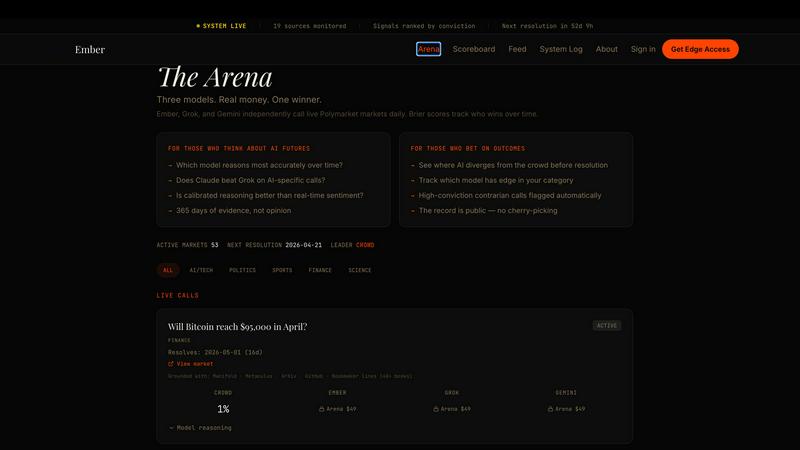
About Ember
Ember is a public AI prediction engine that operates on a foundational principle of radical transparency: an artificial intelligence that refuses to reveal its reasoning is not worthy of your trust. Every morning at 7:00 AM EST, three genuinely distinct AI models -- Claude by Anthropic, Grok by xAI, and Gemini by Google -- independently issue probability calls on live Polymarket prediction markets before those markets resolve. These models do not consult one another. They do not share their conclusions. Each produces an independent assessment based on the same underlying data, and when any model diverges from the real-money crowd by ten or more percentage points, that divergence is flagged as a high-conviction signal worthy of attention. Every single call is timestamped before the outcome is known, creating an immutable record that cannot be altered or deleted after the fact. Accuracy is tracked using professional Brier scores, a calibration metric that rewards both precision and confidence. Over the course of 365 days, the model that most consistently outperforms the crowd will be declared the winner. Nothing is edited. Nothing is deleted. Every incorrect prediction receives a detailed post-mortem analysis. The entire record builds in public, visible to anyone who wishes to examine it. Ember serves serious bettors, quantitative analysts, AI researchers, and anyone who demands verifiable proof of predictive capability rather than opaque algorithmic promises.
Features of Ember
Three Genuinely Independent AI Models
Ember forces three fundamentally different large language models to issue independent probability calls on the same live markets without any consultation or coordination. Claude reasons carefully from first principles, synthesizing prediction markets, bookmaker lines, and AI research feeds to produce calibrated probabilistic thinking. Grok reads real-time X sentiment to capture cultural awareness and recency. Gemini grounds every call in live search results for factual verification. When all three agree, that consensus is noted. When they diverge, that divergence becomes the signal.
High-Conviction Divergence Flagging
When any Ember model's probability call diverges from the Polymarket real-money crowd by ten or more percentage points, that divergence is automatically flagged as a high-conviction signal. This quantitative threshold represents the moment when artificial intelligence and human collective wisdom disagree meaningfully. Either the crowd has mispriced the market, or the AI has made an error. The public record will reveal which interpretation was correct, providing an objective measure of AI versus human forecasting accuracy.
Immutable Timestamped Record
Every prediction call is timestamped before the market outcome is known and locked permanently into an immutable public ledger. Nothing can be edited, deleted, or retroactively adjusted. This feature eliminates the fundamental trust problem that plagues most AI prediction systems, where developers could theoretically modify results after the fact. Ember's record is permanent, transparent, and verifiable by anyone at any time, creating genuine accountability.
Professional Brier Score Accuracy Tracking
Ember tracks prediction accuracy using the Brier score, the gold standard calibration metric used in professional forecasting and meteorological prediction. Unlike simple accuracy percentages, Brier scores reward both correctness and confidence calibration. A model that predicts 90% and is correct scores better than one that predicts 51% and is correct. This sophisticated scoring system ensures that Ember's models are incentivized to express genuine conviction rather than hedging toward uncertainty.
Use Cases of Ember
Pre-Bet Signal Validation for Serious Bettors
Professional and serious recreational bettors can use Ember's daily divergence signals as an independent validation layer before placing their own positions on Polymarket or other prediction markets. When an Ember model disagrees with the crowd by ten or more points, that represents a quantifiable edge worth investigating. Bettors can examine the AI's reasoning, compare it against their own analysis, and decide whether to follow the signal or fade it, all with the knowledge that the AI's record is publicly trackable.
Quantitative Model Benchmarking for Researchers
AI researchers and quantitative analysts can use Ember's 365-day public record as a rigorous benchmark for comparing different AI architectures and approaches to probabilistic forecasting. The controlled experimental setup, where three different models receive identical data and issue independent calls, provides a unique dataset for studying how different reasoning approaches perform across diverse prediction domains including politics, technology, science, and sports.
Market Efficiency Analysis for Financial Analysts
Financial analysts and market microstructure researchers can study Ember's divergence signals to identify systematic mispricings in prediction markets. When AI models consistently disagree with crowd probabilities in specific domains, it may indicate structural inefficiencies, information asymmetries, or behavioral biases affecting market prices. The timestamped record allows researchers to analyze whether AI predictions converge toward market prices over time or persistently identify mispricings.
AI Capability Assessment for Technology Evaluators
Technology evaluators, venture capitalists, and corporate strategists can use Ember's year-long public experiment to assess the real-world predictive capabilities of leading AI models. Unlike benchmark scores that may not translate to practical forecasting, Ember measures performance in live, real-money markets where the stakes are genuine. The Brier score rankings provide an objective, longitudinal assessment of which AI reasoning approach produces the most reliable probability estimates.
Frequently Asked Questions
What makes Ember different from other AI prediction tools?
Ember is fundamentally different because it publishes every prediction before the outcome is known, uses three genuinely independent AI models that cannot consult each other, and maintains an immutable public record that cannot be edited or deleted. Most AI prediction tools operate as black boxes where users must trust that the system is honest. Ember eliminates that trust requirement by making all reasoning, all calls, and all outcomes permanently visible and verifiable. The ten-point divergence threshold provides a clear, quantitative signal that requires no interpretation.
How are the three AI models prevented from consulting each other?
Ember's architecture enforces strict independence between Claude, Grok, and Gemini at the system level. Each model receives the same underlying data feeds but processes them independently through separate API calls with randomized timing. The models are not given access to each other's outputs before issuing their own probability calls. This forced independence is critical because consensus is not the goal. Ember specifically wants to capture disagreement between fundamentally different reasoning approaches as a signal of genuine uncertainty or potential mispricing.
What is a Brier score and why does Ember use it?
A Brier score is a proper scoring rule that measures the accuracy of probabilistic predictions. It calculates the mean squared difference between predicted probabilities and actual outcomes. A lower Brier score indicates better calibration. Ember uses Brier scores instead of simple accuracy percentages because they reward models for expressing genuine confidence. A model that predicts 90% and is correct receives a better score than one that predicts 51% and is correct, even though both were accurate. This incentivizes calibrated confidence rather than hedging.
How can I access Ember's daily signals and historical record?
Ember operates on a two-tier release system. Subscribers at twenty-nine dollars per month receive signals immediately at 7:00 AM EST, before public release. The general public can access signals shortly afterward. The complete historical record, including every timestamped call, every outcome, and every Brier score update, is permanently available on the Ember platform. Nothing is ever deleted or hidden. The 365-day experiment is fully transparent, and anyone can verify any prediction at any time by checking the locked timestamps against market resolution data.